Montesquieu's Impact After The Enlightenment
Written by : Trevor Todd
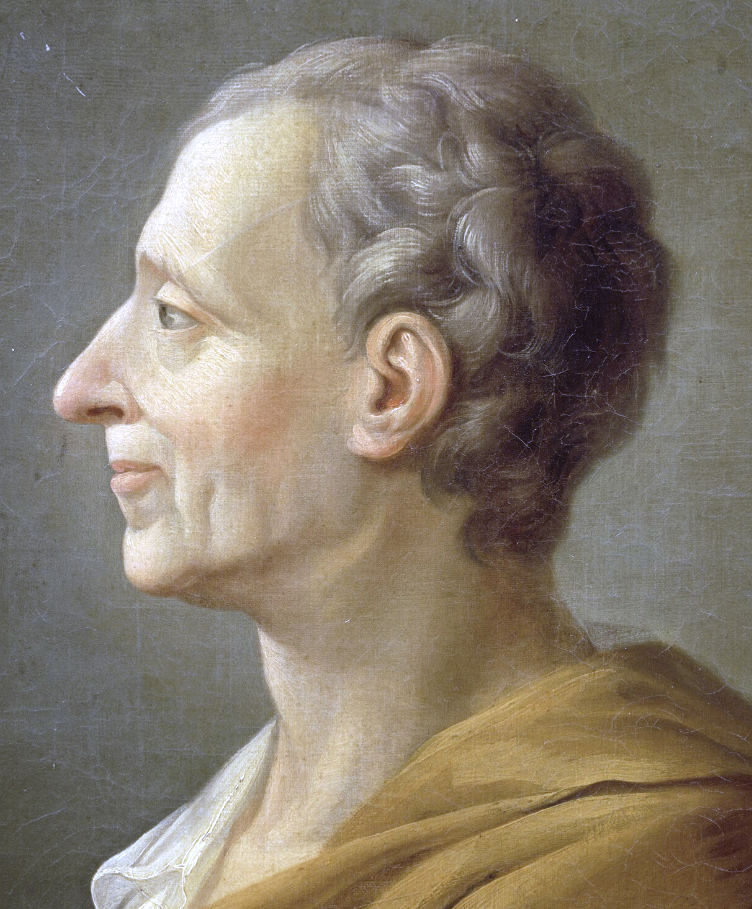 The world today is composed of many advanced systems in society, but they didn't just appear out of nowhere. One defining point in the history of intellect and culture was the Age of Enlightenment. This period significantly influenced many important aspects of life today and had a profound impact on both Europe and the Americas. It brought forth many important thinkers, one of whom is the focal point of this essay, Montesquieu.
Montesquieu was born on the 18th of January, 1689, and was a French judge, historian, and political philosopher. He was a counselor of the Bordeaux Parlement during a time of large governmental change. He left his position later on to pursue writing and studies; his first successful composition was in 1721 with Lettres persanes, and from there his success only grew. His writings gradually gained more attention until 1748, when he published The Spirit of Law, which was quickly translated into English and became one of his most influential works.
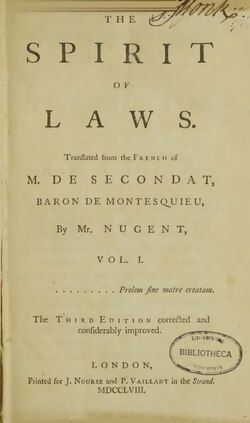 In Montesquieu's The Spirit of Law, he goes in depth about government descriptions and the differences between each one. However, the main point of this writing was his beliefs of governments eventually becoming corrupt if left unchanged. He states that, “It is there only when there is no abuse of power. But constant experience shows us that every man invested with power is apt to abuse it, and to carry his authority as far as it will go.” (Montesquieu 11:4) He argued that it could be prevented if the government was split up into branches, a legislative branch, an executive branch, and a judicial branch. Each branch would have equal power, and they'd use checks and balances to agree on things. This system of government, which he proposed, was the most important and influential for British colonies in North America. (Bok, 2014)
When the British colonies were establishing the United States government, Montesquieu's ideas were used in the formation of the United States government, and it is very easy to see the inspiration. The United States government used the same branches and checks and balances that he had proposed, and it has been unchanged ever since. His influence is also apparent in the Federalist Papers, which James Madison, known as a founding father for the constitution, contributed to. Statements like “Again, there is no liberty, if the judiciary power be not separated from the legislative and executive.” (Montesquieu 11:6) made Americans refer to him as a champion of liberty.
In conclusion, democratic governments would not be the same without the great innovation of Charles Louis de Secondat, Montesquieu. His brilliant concepts for government improvement are the reason why places like the United States have such a fair system of justice. His impact is immense, and we have him to thank for the lack of corrupt leaders in democratic governments, and he will forever be remembered as one of the greatest thinkers of the Age of Enlightenment.